
You've won the contract. What happens to your social value commitments now?
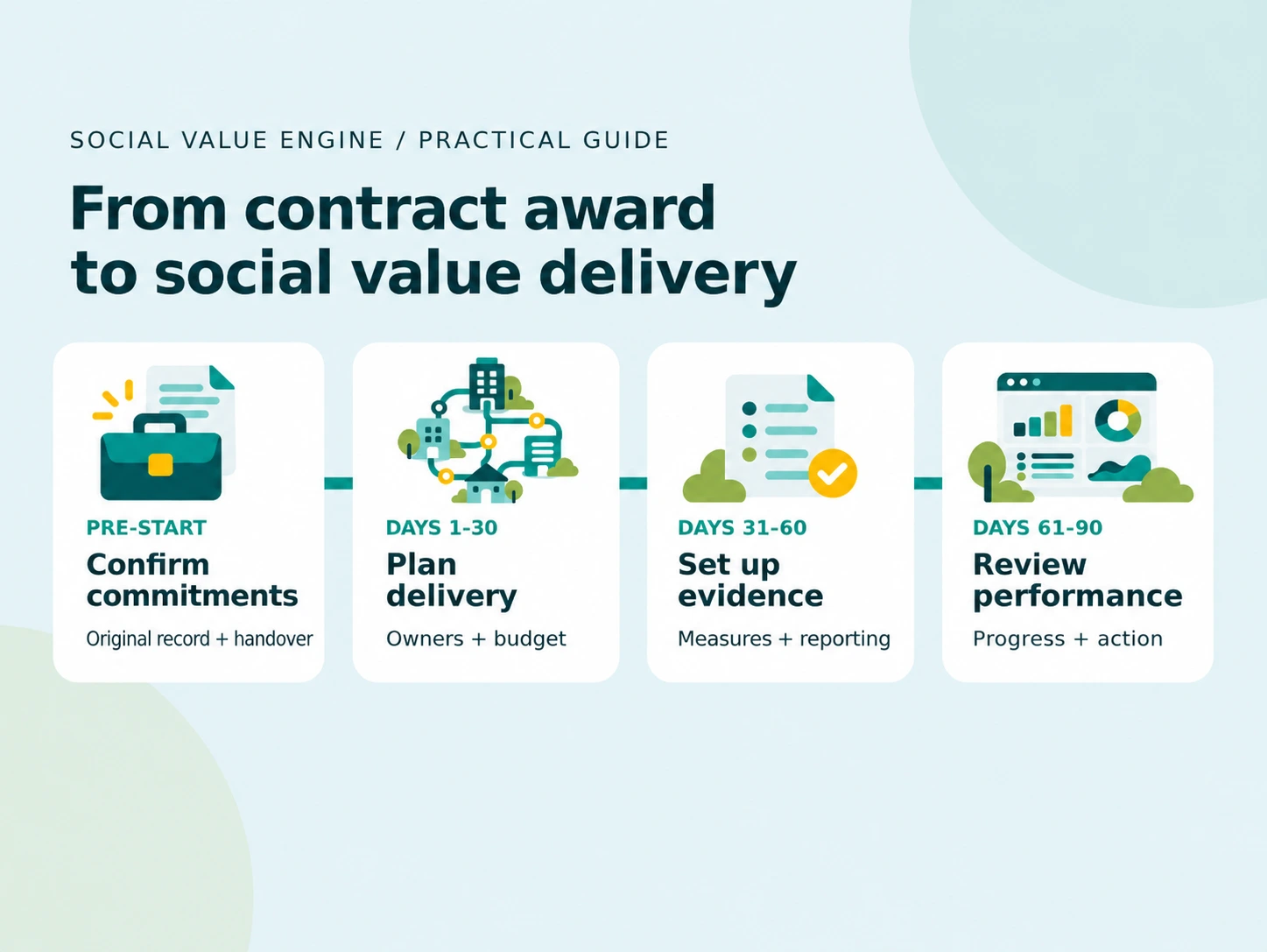
After winning a public contract, confirm the accepted social value commitments, assign delivery responsibilities, agree measures and evidence with the buyer, and establish a reporting timetable before delivery begins.
After winning a public contract, confirm the accepted social value commitments, assign delivery responsibilities, agree measures and evidence with the buyer, and establish a reporting timetable before delivery begins.
Bring the bid manager, supplier social value lead, project manager and buyer's contract manager into the handover. Together, they need to establish what was accepted, who will deliver it and how progress will be checked. Our guide to preparing deliverable commitments before submitting a bid covers the work that should precede this stage.
The first 90 days below are our suggested mobilisation sequence. The sequence is optional; the contract's requirements determine the timetable. Adapt it to the contract's start date, duration and delivery milestones. Agree evidence and reporting before the first activity, even if it starts in week one.
Which policy and reporting rules apply?
Start with the procurement documents and awarded contract. PPN 026 applies to covered procurements under the Procurement Act 2023 by central government departments, their executive agencies and non-departmental public bodies, worth at least £1 million including VAT and meeting the applicable public-contract threshold. It should be applied where the tender notice is published on or after 1 January 2027. Other public bodies may adopt the approach. Private utilities contracts and contracts primarily for overseas delivery are outside its scope. See the policy note and practitioner guidance, sections 1.2 and 2.2.
For a contract awarded now, in November 2026, do not assume PPN 026 applies automatically. Earlier Procurement Act procurements are encouraged to transition, with the previous model available in the circumstances described in the policy note. Framework call-offs may follow the model in use when the framework was awarded: the guidance identifies PPN 002 for frameworks procured from 24 February 2025 to before 1 January 2027, and PPN 06/20 for those procured from 1 January 2021 to before 24 February 2025. Check the framework's award procedure and the contract's procurement regime before applying reporting or change rules.
This guide's handover and evidence practices can also support earlier contracts. Our October guide to the current PPN 026 reporting requirements explains the wider policy.
Keep three reporting processes separate
| Process | Who is responsible? | Timing and purpose |
|---|---|---|
| Contractual social value updates | Supplier submits; buyer reviews | Follow the contract's agreed timetable, which could include monthly mobilisation updates. Track all accepted commitments, evidence, risks and corrective action. |
| Published contract performance notice | Contracting authority | Where Procurement Act KPI reporting applies, assess performance at least every 12 months and on termination, and publish the required assessment information. PPN 026 additionally expects social value KPI performance reporting at least annually for its in-scope £5 million-plus contracts. |
| Quarterly social value return to the Cabinet Office | Central government department | Under PPN 026 section 5.3, departments should report numerical and social value KPI attainment data each financial quarter where Standard Reporting Metrics have been used. Arrange supplier data cut-offs to support this separate return. |
For in-scope contracts valued at £5 million or more including VAT, PPN 026 says to set at least one Social Value Model KPI in addition to the wider Procurement Act KPIs. It should be published on the central digital platform, or elsewhere if that platform cannot be used. Below £5 million, appropriate contractual monitoring still applies and a social value KPI is encouraged where appropriate. See section 4.5.
The Act's general duty is worded differently: section 52 normally requires at least three KPIs before entering a public contract valued at more than £5 million. Exceptions include frameworks themselves, private utility contracts, concessions and light touch contracts, and where performance cannot appropriately be assessed through KPIs. Call-offs can fall within the duty. Devolved Welsh arrangements require the relevant Welsh guidance.
The official KPI guidance distinguishes assessment of all section 52 KPIs from the statutory notice's reporting of the three most material at that time. PPN 026 expects its social value KPI to be included as well. The buyer should establish how it will meet both requirements; a supplier's spreadsheet does not itself discharge the authority's publication duty. See also the contract performance notice guidance.
Before mobilisation: confirm exactly what was agreed
Compare the final tender response, accepted clarifications, implementation plan and any partner letters with the signed contract and its schedules. Check contractual precedence if documents differ. Raise omissions or ambiguity with the authorised commercial lead rather than choosing the easiest interpretation.
Create a commitment register with a unique reference for each promise. Record:
- The accepted wording and its source document, version and contractual reference.
- The quantity, unit, target cohort, geography, quality standard and deadline.
- The baseline and what this contract adds to existing activity.
- The supplier owner, buyer reviewer and any delivery partner.
- The agreed evidence, reporting frequency and route for escalation.
Preserve a read-only copy of the original record. Keep later operational plans and approved changes linked to it. A mobilisation meeting should clarify delivery arrangements; it should not quietly remove a commitment that influenced the award.
Days 1–30: build an owned, funded delivery plan
Assign responsibilities on both sides
Give each commitment one named supplier owner with authority to organise delivery and a deputy for absence. Name the buyer's reviewer and the person authorised to approve contractual changes. The bid manager should explain assumptions and unresolved dependencies before handing over.
Where a charity, college or subcontractor will deliver, agree its tasks, capacity, costs, referral arrangements and evidence deadlines. The contractual supplier remains accountable to the buyer unless the contract provides otherwise. A partner's missed milestone needs a supplier response, even where the supplier did not cause it.
Confirm the budget, milestones and dependencies
Translate each target into dated steps. Six placements may require recruitment, eligibility checks, supervisor allocation, accessible equipment, induction and completion reviews. Put those steps into the main project plan.
Confirm the budget holder and funding for wages, paid learning time, supervision, partner fees, travel, accessibility and reporting. Record staff capacity as well as cash. Do not assume a delivery partner can absorb unagreed costs.
Identify risks early: delayed security clearance, insufficient referrals, mentor availability or a training provider's lead time. Give each risk an owner, likelihood, impact, mitigation and a trigger for escalation. Plan participant support and progression at the end of the activity, as well as recruitment.
Agree evidence before the first activity
For each target, ask what record will substantiate completion. Paid placements need appropriate pay and participation evidence; training hours need attendance and duration records. A booking or invitation cannot demonstrate completion.
Agree who collects records, who checks them, where they are held and when the buyer can review them. Use proportionate data sharing, clear access controls and retention arrangements. Confirm the lawful basis and privacy information with the relevant data protection lead; avoid sending entire personal case files when an eligibility confirmation will do.
Days 31–60: establish reporting and test the evidence process
Use our guide to setting measurable social value KPIs to settle definitions, counting rules, targets, milestones and evidence. Confirm whether a figure is for the current period or cumulative, whether it counts people, hours or events, and how shared activity will be allocated without double counting.
Under PPN 026 section 4.5, use Standard Reporting Metrics where provided for the selected sub-criteria. Where none is provided, adapt a metric or agree a new one; the guidance also addresses adaptation to avoid discrimination against treaty-state suppliers. Keep a mapping from each contractual measure to the relevant official metric, recording any custom indicators separately.
Agree reporting periods, submission dates, the buyer's review time, feedback and sign-off. Set performance rating thresholds and an escalation route. Work backwards from any departmental return or public notice deadline so there is time to check evidence.
Test the process with a sample record before the first deadline. Can a partner provide the agreed information securely? Can the supplier reconcile the total to individual records? Can the buyer check it without requesting unnecessary personal data? Resolve gaps while records can still be collected.
Days 61–90: monitor delivery and act on early problems
At the agreed review, separate planned, started and completed activity. Show actual delivery against the milestone due for that period, alongside the full contract target. An annual commitment may legitimately have no completions in month one.
Record missing evidence separately from confirmed non-delivery. Do not mark an unsupported claim as verified, or turn missing data into a confident zero without checking. Explain the limitation, who will resolve it and by when.
Discuss risks with the buyer before a deadline is missed. Agree corrective action with a named owner and review date. Check whether the intervention is working at the next meeting. Keep participant feedback and any measured progression alongside the activity figures, without treating attendance as proof of a sustained employment outcome.
Fictional worked example: an £8 million IT services contract
All quantities, milestones and delivery arrangements in this example are illustrative. Assume a central government IT services contract worth £8 million including VAT, procured under the Act with a tender notice after 1 January 2027 and PPN 026 applied. These targets are not policy minimums or a suggested offer for every IT contract.
The accepted year-one commitments are six paid placements, 120 person-hours of technical training for an agreed future-workforce cohort and 24 career-mentoring sessions. The bid manager preserves the final response and the supplier social value lead creates three register entries.
| Accepted commitment | Delivery owner and resources | Illustrative milestones | Evidence and review |
|---|---|---|---|
| Six completed paid, four-week placements in year one | Service desk manager; agreed wages, supervision and travel budget | Referral route confirmed by day 30; first three starts in month three; all six completions by month 12 | Eligibility confirmation, dates, attendance, proportionate pay records and completion sign-off; monthly supplier update |
| 120 person-hours of technical training for the defined future-workforce cohort in year one | Learning lead; trainer, accessible venue and learning materials funded | Programme agreed by day 30; sample record checked by day 60; 30 person-hours delivered by day 90 | Participant attendance and hours, course content and provider confirmation; monthly update checked by buyer |
| 24 career-mentoring sessions in year one for the agreed cohort | Mentoring lead; mentors' staff time and partner coordination funded | Mentors briefed by day 30; six sessions completed by day 90 | Dated session logs with duration and participant confirmation, avoiding sensitive discussion notes; monthly update |
The learning lead maps the training measure to Annex B metric 2av, person-hours of training addressing identified skills gaps in target communities or cohorts in the future contract workforce. That mapping depends on the selected criterion and actual activity. Ten eligible people attending three hours each would contribute 30 person-hours, not ten hours or 30 people.
“Six completed paid placements” is a contract-specific indicator here. Do not label it as metric 2ai, which concerns T-Level industry placements, unless the placements actually meet that definition. Metric 2ciii concerns work experience in high-growth innovative industries; an IT contract alone does not establish eligibility. Likewise, “24 mentoring sessions” is a custom session count. Metric 2bii measures hours of career support and guidance for the workforce, not sessions for a future-workforce cohort. Keep the cohort and unit accurate rather than forcing a match.
At the day-90 review, suppose three placements have started but none has completed, 30 person-hours of training are evidenced and six mentoring sessions are complete. Report zero placement completions, three starts, then compare that position with the agreed placement timetable. Do not present starts as completions. The contract manager checks the training and mentoring evidence, records any outstanding checks and agrees the next milestones.
Our guide to evidencing employment and training outcomes explains the additional evidence needed for qualifications, progression and sustained employment.
What if commitments are delayed or need to change?
A temporary delay calls for an explanation, recovery action and a review date. Likely non-delivery needs prompt escalation through the contract's performance process. Separate a revised operational step that stays within the agreed obligation from a proposed change to the obligation itself.
If a partner withdraws, check alternatives, resources and the effect on participants. Tell the buyer what can still be achieved. Do not replace six placements with six mentoring sessions on the assumption that equal counts mean equal commitments.
For a contractual change:
- Record the original promise, current performance and reason for the proposal.
- Assess effects on beneficiaries, value, delivery, evidence, targets and deadlines.
- Ask the buyer's authorised commercial and legal teams to assess the applicable rules. For Act contracts, section 74 and Schedule 8 govern permissible modifications; contract change notices or publication of the modification may also be required. Earlier-regime contracts need the relevant rules for that regime.
- Obtain the required approvals and document the authorised variation, effective date and revised reporting arrangements.
- Retain the original commitment, request, assessment, approval and version history. Explain any change in later reports.
An agreement between supplier and buyer does not, by itself, make a modification lawful. This guide provides practical contract-management advice, not legal advice.
PPN 026 allows investigation and appropriate adjustment of performance measures, but this is not permission to erase poor delivery. The contract performance notice guidance explains when particular breaches or failure to improve after a proper opportunity trigger publication. Such failures may be relevant to discretionary exclusion from later procurements; a single missed milestone does not automatically exclude a supplier.
What should the first social value performance report contain?
Use the same commitment references as the contract register. A useful first report includes:
- Context: contract reference, reporting period, cut-off date, preparer and reviewer.
- Baseline and promise: original wording, unit, cohort, geography, target and deadline, plus any authorised variation.
- Milestone and actual delivery: what was due, this-period and cumulative figures, and planned, started and completed status.
- Evidence: record references, validation status, gaps and any allocation to other contracts.
- Variance and rating: the difference from the milestone, reasons and assessment using the agreed method.
- Risks and corrective action: owner, resources, action deadline and escalation decisions.
- Next steps: upcoming milestones, buyer decisions required, next review and next report date.
Link to controlled evidence rather than attaching unnecessary personal information. Keep the buyer's review decision and any corrections with the report. An honest early update can show work completed on referrals, staffing and evidence setup even before delivery totals increase.
Social Value Contract Mobilisation Checklist
Download a self-contained, accessible HTML checklist to save, open offline or print. It includes the phases below and a repeatable record for each commitment. The same usable checklist is provided here, so the download is optional.
Pre-start
- Compare the final bid, clarifications and partner letters with the contract.
- Confirm the applicable procurement regime, social value policy and publication duties.
- Record each original commitment, contractual reference, target, unit, cohort, geography and deadline.
- Preserve the original version and resolve ambiguities with the authorised buyer.
Days 1–30
- Name the supplier owner, deputy, partner contact, buyer reviewer and escalation lead.
- Confirm budget, staff capacity, participant support and partner responsibilities.
- Set dated milestones, dependencies and risk mitigations.
- Agree evidence sources, collectors, checks, access and retention before activity starts.
Days 31–60
- Agree counting rules, applicable Standard Reporting Metrics and any custom indicators.
- Set reporting frequency, cut-off, submission, review and publication responsibilities.
- Agree performance thresholds and how to handle missing evidence and double counting.
- Test a sample record and the partner's secure data-sharing process.
Days 61–90
- Reconcile planned, started and completed activity with the milestones.
- Validate evidence and explain gaps, variances and risks.
- Agree corrective actions with owners and dates; use formal change control where needed.
- Review the first report with the buyer and confirm the next reporting date.
Repeat this record for every commitment
Record the original wording and contract reference; owner and reviewer; target, unit, cohort and geography; baseline; budget and partner role; milestone and due date; evidence source, collector and check; reporting frequency and next date; risks, mitigation and escalation trigger; actual progress and corrective action; and change reference and approval.
Keeping the delivery record together
SVE Delivery supports managing social value commitments across contracts and programmes, tracking targets, progress and evidence. Keeping the accepted commitment linked to its delivery record helps teams prepare for review. Our procurement solutions explain the wider approach to managing social value beyond contract award.
To discuss how that could fit your contract-management process, speak to the team.
Sources and review date
Prepared and source-checked on 11 November 2026. Check the current guidance and your contract documents before making decisions.
- Cabinet Office: PPN 026 policy note, particularly scope, timing and paragraphs 16–18.
- Guidance on using PPN 026, particularly sections 1.2, 2.2, 4.5, 5.1–5.3 and Annex B.
- Procurement Act guidance: Key Performance Indicators, particularly paragraphs 9–17.
- Procurement Act guidance: Contract Performance Notices, covering assessment, publication and poor performance.
- Procurement Act guidance: Contract Modifications, covering permitted grounds and transparency requirements.
Frequently asked questions
Expand a question to read the answer.
Potentially, but the supplier cannot change it unilaterally. Use the contract's authorised change process and have the buyer assess the applicable procurement rules, including any notice requirements. Keep the original commitment, reasons, approvals and revised wording. Agreement alone does not establish that a modification is lawful.
The contractual supplier remains accountable to the buyer unless the contract provides otherwise. Agree the charity's tasks, resources, evidence and reporting dates, and make sure the supplier has a recovery plan if the partner cannot deliver.
Follow the agreed contractual timetable. Monthly updates can help mobilisation, but there is no universal monthly supplier-reporting duty in PPN 026. Published contract performance notices and departments' quarterly Cabinet Office returns are separate processes.
Report zero completed activity where that is accurate, alongside planned starts, progress against milestones and risks. Distinguish activity not yet due from a missed deadline, and missing evidence from confirmed non-delivery.
Usually not on its own. A photograph may support a record, but does not normally establish participant eligibility, paid status, duration, completion or attribution to the contract. Agree evidence that substantiates the particular claim and protect personal information.
No. PPN 026's additional social value KPI expectation applies to in-scope contracts valued at £5 million or more including VAT; below that, appropriate contractual monitoring still matters. The Procurement Act's general three-KPI duty applies above £5 million, subject to exceptions. Check the authority, procurement regime, dates, contract type and applicable policy.
A relevant supporting document can be referenced again, but the same delivery must not be claimed twice. Record which contract each activity belongs to and any agreed allocation where delivery is shared. A corporate policy can support several contracts without proving that each contract delivered the same result.
Stay informed
Get insights on social value delivered to your inbox