
What is new in the 2026 Magenta Book, and what it means for social value measurement
HM Treasury has published the most significant revision of the Magenta Book since 2020. The new edition strengthens the treatment of value for money, introduces a dedicated section on place-based evaluation, and addresses AI in social research for the first time.
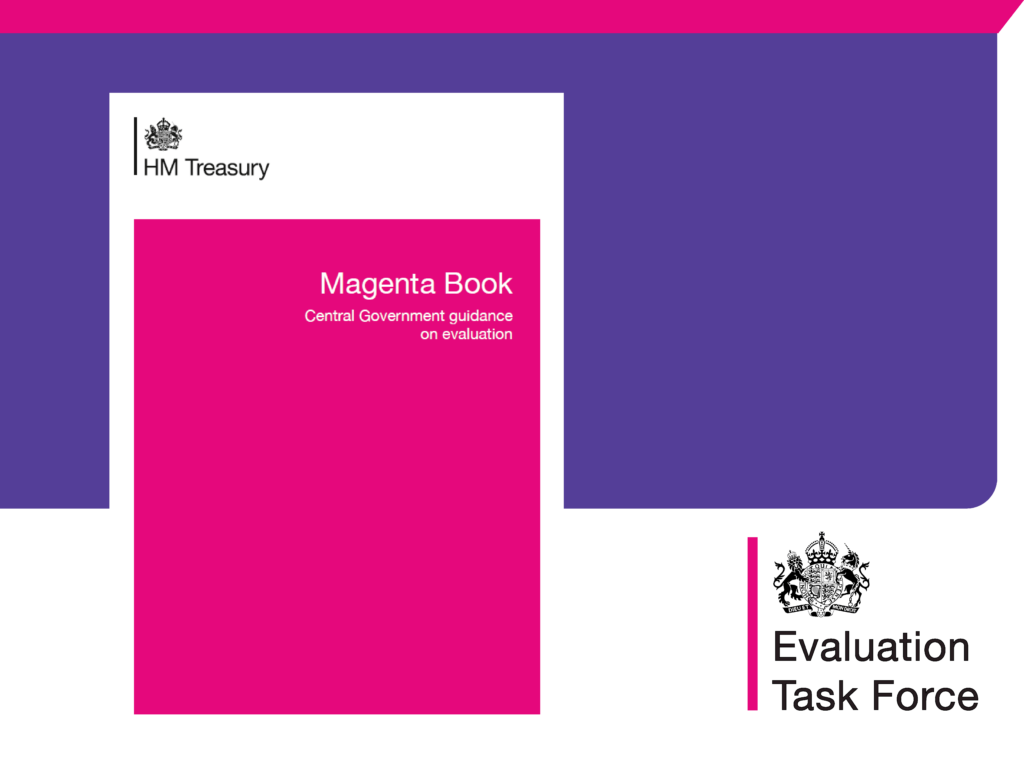
HM Treasury has published a substantially revised edition of the Magenta Book, the government's central guidance on evaluation. The joint Cabinet Office and Treasury Evaluation Task Force has described it as the most significant revision since the 2020 edition. The new version runs to around 160 pages and is written for the policy, delivery, finance and analysis professions. For anyone working in social value measurement, it resets the standard that commissioners and funders use to assess the quality of evidence.
The Magenta Book is aimed at central government, but its influence reaches further. It shapes how public bodies describe good evaluation, and that language filters through to commissioners, funders and the VCSEs that deliver services. Several of the changes in this edition speak to questions that social value practitioners already work through, particularly around value for money and place.
What is new in the 2026 Magenta Book
The framing from the Evaluation Task Force is a move from measuring what happened towards learning how to improve while a programme is still running. That intent runs through the main additions.
Value for money has been redrafted and given its own annex. It offers a clearer definition and expanded methods for judging how well public resources are used, and it brings non-monetisable social costs and benefits into the assessment rather than limiting value for money to what can be priced. For anyone using Social Return on Investment (SROI), this is a useful signal. Monetising outcomes through financial proxies still matters, and a credible value for money case has to account for what cannot easily be given a number as well as what can.
The edition also includes new guidance on the responsible and ethical use of artificial intelligence in social research and evaluation, the first time the Magenta Book has addressed AI directly. Alongside this, it sets out principles for research transparency, including pre-registering evaluation protocols and sharing analytical code through open platforms, with the aim of making evaluations easier to scrutinise.
For the first time, there is a dedicated section on place-based evaluation, covering the specific considerations that apply when an intervention is designed for a particular area. The addition reflects the wider policy direction towards place, seen in the Local Outcomes Framework and in recent work on place-based funding.
A new annex frames test and learn as a way of working, using social research to adapt an intervention before committing to full-scale impact assessment. The guidance also brings benefits management closer to monitoring and evaluation, and it remains aligned with the Green Book, the Treasury's guidance on appraisal.
Why it matters for social value measurement
Two threads stand out.
The first is value for money. Commissioners are increasingly asked to show that spending delivers outcomes rather than outputs alone, and the revised guidance gives them firmer ground for weighing benefits that are hard to price. A well-constructed theory of change, supported by monetised proxies alongside qualitative evidence, fits that expectation. At the Social Value Engine we have long held that a defensible number is only as good as the reasoning behind it, and the 2026 Magenta Book makes that view a firmer part of the official standard.
The second is place. Evaluating an intervention in a specific area means understanding local need before judging what changed, and capturing the experience of the people affected. The new place-based section formalises considerations that place-focused organisations have been applying in practice for some time.
What practitioners can take from it
The revised Magenta Book does not change what social value measurement is for, though it does sharpen the standard that evidence will be held to. Organisations that already build evaluation into design and pay attention to local context will find much of the guidance familiar. For anyone reviewing their approach, the 2026 edition is a sensible reference point, and you can read it in full on gov.uk. For more on how the main methodologies fit together, see our explainer on the difference between SROI and the TOMs Framework.
Frequently asked questions
Expand a question to read the answer.
The Magenta Book is HM Treasury's central guidance on evaluation in government. It is written primarily for policy, delivery, finance, and analysis professionals working on public programmes, but its influence extends beyond central government: it shapes the evaluation standards that commissioners, funders, and suppliers are expected to meet. For social value practitioners, it sets the benchmark for what constitutes credible evidence of impact.
Stay informed
Get insights on social value delivered to your inbox