

Social value is the quantified measure of the relative improvement in people's lives that results from an activity, project or investment. It accounts for environmental, social and economic outcomes not captured in traditional financial accounting, expressed as a structured monetary figure.

Most definitions of social value are vague enough to mean very little. Stripped back, the idea is straightforward. Social value is the quantified measure of the relative improvement in people's lives that results from an activity, project or investment.
Traditional financial accounting tracks economic transactions: the cost of a brick, the wage paid for an hour of work, the return generated by a contract. Social value accounts for something broader. It captures the environmental, social and economic outcomes of that activity, with particular attention to the value experienced by the people affected. It puts a structured, monetary figure on changes that markets do not price directly, such as reduced isolation, improved confidence or better access to green space.
The formal definition used across the sector, and the one the Social Value Engine works to, describes social value as the relative importance that people place on the changes they experience in their lives. Some of that importance is reflected in market prices. A great deal of it is not, and that is the gap social value measurement exists to close.
Output, outcome and social value: three different things
A common problem in social value writing is that these three terms get used interchangeably. They are not the same, and the difference is where most of the confusion in this field comes from.
Consider a community mental health and gardening project.
- The input is what goes in: a £50,000 budget.
- The output is the activity itself: running a ten-week project for thirty socially isolated individuals.
- The outcome is the change that activity produces: participants report reduced loneliness, more regular physical activity and higher self-reported wellbeing.
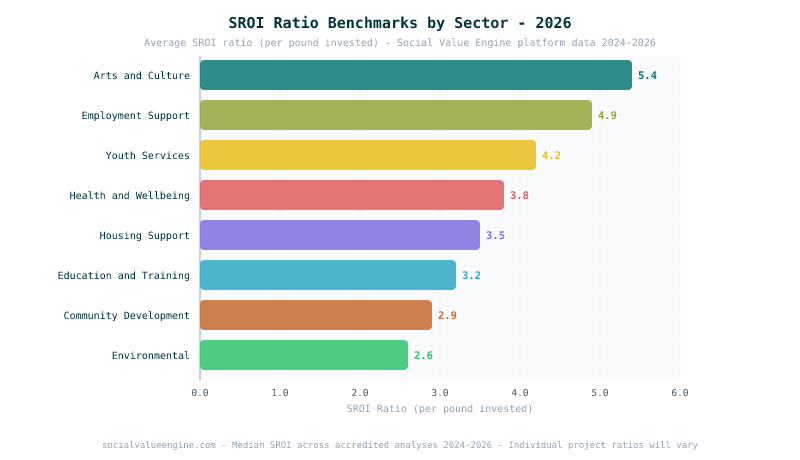
- The social value is that outcome expressed as a structured monetary figure. By applying a research-backed financial proxy to the specific reduction in isolation, and adjusting that figure honestly, an organisation can express the result in comparable terms. For illustration, a project might report that every £1 invested generated around £3.50 of wider social value to the community. The exact ratio will always depend on the project, the evidence and the adjustments applied.
The shift from counting outputs to valuing outcomes is the whole point. Counting how many people attended a project tells you what was delivered. Valuing the change tells you whether it was worth doing.
How is social value calculated?
Turning a qualitative change into auditable data follows a clear sequence, grounded in a small number of principles.
Stakeholder engagement
You cannot assume what people value. You have to ask the people affected what changed for them and how much it mattered. This keeps the analysis honest and stops it drifting towards what the funding organisation would prefer to hear.
Financial proxies
Many of the outcomes that matter most, such as increased confidence or reduced anxiety, have no market price. A financial proxy assigns a monetary value to that non-market change, drawn from research and established datasets so the figure is defensible rather than invented. The Social Value Engine uses a library of more than 650 research-backed financial proxies, sourced from over 100 separate research bodies, so that each value used in an analysis can be traced to its origin.
Deadweight, attribution and other adjustments
A credible figure has to account for what would have happened anyway (deadweight) and for the contribution of others (attribution). Alongside these sit further adjustments such as displacement and drop-off. Applied together, these deflate the headline figure to something honest and robust enough to stand up to scrutiny. A social value calculation that skips this step tends to overstate impact, sometimes by a significant margin.
You can read more about how these adjustments work in our guide to impact adjustments and deflators.
Why social value matters across sectors
The reason social value has moved from the margins to the mainstream looks slightly different depending on where you sit.
In public procurement and local government, social value is now a formal part of how public money is spent. The Public Services (Social Value) Act 2012 first required commissioners to consider economic, social and environmental wellbeing when procuring services. Subsequent guidance, including the Procurement Act 2023 and the Social Value Model set out in PPN 002, has built on that foundation. Public sector buyers are expected to evaluate how the services they commission improve the places they serve, not just whether they were delivered on time and on budget.
For housing associations and further education colleges, social value provides evidence of return. Housing associations remain within scope of the Procurement Act 2023, and both sectors face boards, regulators and funders who want proof that spending on community infrastructure, training and asset management produces a genuine local multiplier. A robust social value figure turns "we believe this matters" into "here is what it delivered."
For charities and voluntary, community and social enterprise organisations, social value strengthens the case made to commissioners and funders. A well-told story about a beneficiary is compelling, but on its own it is an anecdote. A structured, evidence-based social value analysis shows funders precisely why an intervention works and what it returns, which is increasingly what they expect to see before they commit.
The gold standard: SROI and accreditation
Not all social value measurement is equally reliable. The most rigorous approach is Social Return on Investment, or SROI, a framework that expresses social value as a ratio of value created to investment made, built on stakeholder engagement and the adjustments described above.
What separates credible SROI from impact washing is adherence to recognised principles. Social Value International sets out the principles that govern good practice, including involving stakeholders, valuing the things that matter, only claiming what you can evidence, and being transparent about method and assumptions. An analysis that follows these principles produces a figure funders and regulators can trust.
The Social Value Engine is independently accredited by Social Value International, and every analysis on the platform applies SVI methodology. That is what allows the results it produces to carry weight with the people who commission, fund and regulate the work.
If you want to see how this works in practice, you can explore the platform or book a demo.
Frequently asked questions
Expand a question to read the answer.
Social impact refers broadly to the change that an organisation or programme creates in the lives of people and communities. Social value takes that concept further by quantifying and expressing that change in monetary terms, making it possible to compare the value created against the investment required to create it. In practice, the terms are often used interchangeably, but in the context of SROI and formal measurement frameworks, social value implies a monetised, evidence-based assessment rather than a qualitative description of change.
Stay informed
Get insights on social value delivered to your inbox