

What makes high street regeneration socially valuable?
Measure high street regeneration through changes in employment, access to services, wellbeing, participation and the local environment, alongside buildings restored and footfall. Establish a baseline, involve the people affected and follow up outcomes after opening. England's Hope on the High Street strategy and £210 million Community Assets Programme provide a timely reason to plan that evidence before investment.
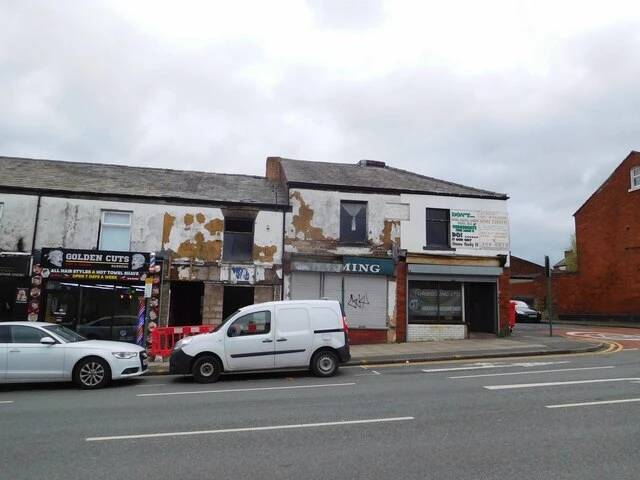
Photo: Market Street and Vernon Street, Hyde, 23 April 2024. © Gerald England, CC BY-SA 2.0. Converted to WebP; displayed crops use the same licence.
High street regeneration creates social value when it improves people's lives. Councils can assess that change through employment, access to services, wellbeing, participation and local economic resilience, alongside physical improvements and commercial activity.
England's Hope on the High Street strategy, published on 28 October 2026, gives local authorities and community organisations a reason to agree how they will evaluate those changes before investment begins.
Policy checked: 11 November 2026. The strategy applies to England. Its accessible HTML version was added on 2 November. Funding arrangements below reflect the official sources available when this article was prepared; check the linked guidance before making an application or spending decision.
What has the government announced for high streets?
The strategy covers reducing vacancy, supporting businesses, improving public safety, strengthening local leadership and making better use of public assets. It is backed by the £210 million Community Assets Programme:
| Programme element | Announced funding | Purpose or current position |
|---|---|---|
| Derelict Buildings Fund | £125 million | Repurposing prominent vacant or derelict buildings across 60 selected local authorities |
| Regional Co-operative Development Programme | £10 million | Supporting Strategic Authorities to develop their co-operative economy |
| High Street Rental Auctions | £10 million | Helping local authorities accelerate and scale rental auctions |
| Community ownership funding | £65 million | Further opportunities to support community takeovers of buildings, with information expected in early 2027 |
These are separate funding routes, with their own arrangements. The total does not mean every council or community group can apply to a single open £210 million fund.
The Derelict Buildings Fund interim guidance sets out allocations of £1 million to £3 million for 60 selected English local authorities. It supports bringing long-term vacant or derelict buildings into productive community or commercial use, diversifying high streets and building local authority capacity.
Projects can include acquisition, restoration and reuse of buildings such as shops, offices, former places of worship, pubs and cinemas. Councils should check the official place list, eligibility and conditions. The guidance asks selected authorities to begin community engagement and longlist buildings by the end of 2026, with first progress updates by April 2027. Detailed funding profiles, project-selection requirements and delivery arrangements remain forthcoming in the sources checked.
Evaluation can begin while proposals are being developed. A baseline and a clear account of the intended beneficiaries will help councils choose between potential uses and judge results later.
What should regeneration programmes measure?
Buildings restored, floorspace improved, investment secured and vacant units occupied show what has been delivered. Footfall, sessions and visitor numbers show how a place is being used. Each is useful, but none establishes every benefit claimed for a regeneration project.
An increase in footfall might reflect a temporary event, a change in counting methods or visitors moving from another street. A new community room might be well used by existing groups while remaining inaccessible to residents without affordable transport.
Separate three questions:
- Outputs: What was delivered, and who used it?
- Outcomes: What changed for people or organisations?
- Sustained change: Did those improvements last, and what else contributed?
Record negative effects too, including disruption during building works, unaffordable rents or the displacement of existing traders.
Five areas of social value to investigate
1. Employment, skills and local enterprise
A reused building may support jobs, training or affordable space for small businesses. Define whether you are measuring new jobs, safeguarded roles, employment starts or sustained employment. Follow up job quality, hours and progression where relevant.
Business records, employment evidence and interviews can help establish what changed. Check whether a business relocated from nearby and whether employment would have grown without the project. Our jobs and skills evidence guide explains how to keep these claims distinct.
2. Access to services and community facilities
A hub could bring advice, learning or support closer to people who previously struggled to reach it. Measure practical changes such as travel time, affordability, service availability and whether people receive the help they need.
Opening hours and attendance records describe provision. Resident feedback and follow-up on referral outcomes help test improved access. Include people who cannot use the facility, so barriers are visible.
3. Health, wellbeing and social connection
Regular activities may create opportunities for social contact or support. Use proportionate baseline and follow-up questions, alongside interviews, to understand whether people feel less isolated or more connected.
Participation alone does not prove improved wellbeing. Explain the sample, response rate and other services or life changes that may have influenced the result. Avoid collecting sensitive health information without a clear need and appropriate safeguards.
4. Community participation, ownership and belonging
Community involvement can influence which buildings are selected, how they are run and who benefits. Record whose views shaped decisions, whether less-heard groups participated and how suggestions were acted on.
Consistent questions about belonging or satisfaction with the area can support follow-up. Community ownership should be assessed alongside accessibility, viable running costs and the ability of residents to influence decisions.
5. Environment, accessibility and perceptions of safety
Better lighting, seating, access routes or building improvements may change how people use a street. Combine access audits and physical measures with residents' accounts of comfort and safety, at different times of day.
Distinguish perceptions of safety from recorded incidents. Consider who experiences the improvement and whether a problem has moved elsewhere. Environmental claims should use evidence suited to the particular change, rather than assuming every refurbished building reduces emissions.
Worked example: an empty shop becomes a community hub
This example is fictional. It illustrates an evaluation approach, not the results of an SVE customer or a funded scheme.
A council and local partners convert a vacant shop into shared space for advice sessions, community activities and enterprise support.
| Measurement level | What the project might record | What the evidence can establish |
|---|---|---|
| Activity | Refurbishment, access improvements and opening date | The space was made available |
| Output | Sessions held, unique visitors and organisations using the space | The scale and pattern of use |
| Outcome | Changes in access to advice, social connection or enterprise capability | Changes reported or demonstrated by participants, subject to evidence quality |
| Longer-term change | Follow-up on sustained participation, wellbeing or employment | Whether benefits persist and what else contributed |
The team records the previous availability of local services, asks residents about access barriers and agrees a small set of follow-up questions before opening. It distinguishes repeat visits from unique people and avoids assuming that everyone attending an activity experiences the same benefit.
If advice sessions attract people who already received equivalent support elsewhere, the additional benefit may be smaller than the attendance total suggests. If the hub reaches residents who previously could not obtain help, that change needs evidence.
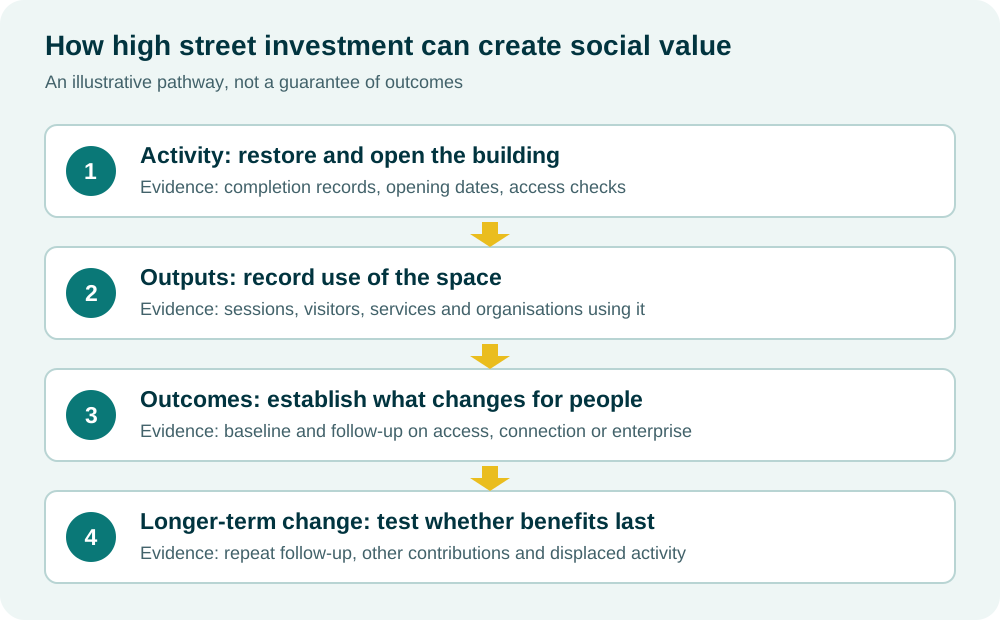
Text version of the diagram: Restore and open the building → record sessions, visitors and services → test changes in access, connection or enterprise → follow up whether benefits last. Evidence is needed at every transition; later outcomes cannot be inferred from earlier activity.
How to build a proportionate evaluation framework
Start with the decision the evaluation will inform: selecting a building, choosing its use, improving delivery or considering future funding.
- Establish the baseline. Record conditions before investment and the date, geography and source of each measure. Place Explorer can help with local context; combine area-level data with building-specific evidence and community knowledge.
- Involve the people affected. Include users, non-users, businesses and neighbouring communities. Ask about intended benefits, barriers and possible harms.
- Map the pathway to change. Develop a theory of change connecting resources, activity, outputs and outcomes. Record the assumptions that need testing.
- Select a small set of useful measures. Define each indicator, its unit, evidence source and collection owner. Match effort to the scale and purpose of the decision.
- Plan follow-up before opening. Agree when change could reasonably appear and how long it may last. Use consistent questions and explain missing responses.
- Assess other influences. Consider deadweight, meaning what might have happened anyway; attribution, meaning others' contribution; and displacement, meaning activity or benefit shifted from elsewhere.
- Use the findings. Review accessibility, opening hours, activities or support when evidence shows a gap. Explain to residents how their feedback changed decisions.
The local authority eGuide covers embedding social value from project inception through evaluation and reporting.
When should councils use SROI?
Social Return on Investment can help value material social outcomes when comparing options, explaining wider public benefit or informing future investment. Use it where financial valuation will improve the decision and the available evidence supports the analysis.
A forecast should identify assumptions about future outcomes. An evaluation should use evidence of changes that occurred. Choose financial proxies that represent those changes, explain their limitations and avoid valuing the same benefit twice.
Account for other contributors and for possible displacement from neighbouring streets. Test material assumptions and report uncertainty alongside the ratio. Our guide to benchmarking social value explains why projects with different populations, scope or evidence cannot be compared through headline ratios alone.
The official programme collection and interim fund guidance reviewed for this article do not establish a general requirement to use SROI. Follow the current rules for the particular funding stream, including any later monitoring guidance.
Download the High Street Regeneration Outcome Planning Sheet
Use this two-page, fillable sheet to plan evidence before investment. It is a suggested evaluation aid, not an official funding application or mandatory government template.
The planning prompts are also available here as text:
| Planning field | What to record |
|---|---|
| Project, place and owner | Building, neighbourhood, lead person and decision to inform |
| Baseline | Starting conditions, sources, geography, dates and evidence gaps |
| Intended change | What should change for people, separately from activity |
| Beneficiaries | Who should benefit, who might be excluded and possible harms |
| Indicators | A small set of defined output and outcome measures |
| Evidence | Sources, collection owner, method and proportionate privacy safeguards |
| Follow-up | Baseline, review dates and expected duration of change |
| Attribution | Partners' contributions and how overlapping claims will be prevented |
| Other effects | Deadweight, displacement and remaining uncertainty |
| Learning | What the findings will change, who decides and when |
Before delivery, agree these responsibilities with partners and make the evaluation affordable to maintain. Keep physical completion records alongside the evidence of what residents experience.
Resident baseline and follow-up survey
Use the companion survey to ask the same short questions before work starts and after the place has been operating long enough for change to be plausible. It covers access, belonging, safety and feeling welcome, with space for barriers and other experiences. Include residents who do not visit, as well as current users.
Copy the questions into your own accessible survey tool or print the resident sheet. The resource explains accessible formats, sampling limitations and privacy safeguards. It does not collect responses. Map its questions to the Outcome Planning Sheet's indicators, evidence, follow-up and learning fields. These are suggested local evaluation questions, not an official government evaluation instrument or a validated scale. Before-and-after differences alone do not prove that regeneration caused the change.
For organisations evaluating regeneration and local investment, Social Value Engine supports evidence-based SROI analysis. Begin with the local needs, intended outcomes and decisions your evaluation must inform.
Frequently asked questions
Expand a question to read the answer.
It can, but the claim needs evidence of what changes for people. Record the building's new use and who can access it, then test outcomes such as improved access to advice, social connection or sustained employment. A completed refurbishment alone does not demonstrate those outcomes.
Footfall is a useful indicator of activity. It does not establish whether residents are better off, businesses are more resilient or people feel safer. Use it alongside measures that address the project's intended outcomes, and consider whether visitors have moved from neighbouring streets.
Use consistent questions about belonging, satisfaction with the area or perceptions of place before and after investment, supported by interviews or discussion groups. Include people who do not use the new facility and explain the limits of the sample.
Ownership can support local influence and access, but benefits depend on governance, affordability, accessibility and financial sustainability. Evaluate the changes people experience rather than assuming that a particular ownership model guarantees a better outcome.
Partners can describe their contribution to a shared outcome, but should make their respective roles explicit and avoid presenting the same benefit as several independent results. Agree reporting boundaries, beneficiary definitions and attribution assumptions before combining figures.
Assess the relevant wider area and record potential losses as well as gains. Businesses or visitors relocating from a nearby street may increase activity at the project site without creating an equivalent net benefit across the town.
The official programme collection and Derelict Buildings Fund interim guidance checked on 11 November 2026 do not establish a general requirement to use SROI. Follow the applicable fund's current monitoring and evaluation requirements. SROI may be useful where the decision and evidence justify financial valuation.
Stay informed
Get insights on social value delivered to your inbox